Global CAR-T Cell Therapy Market Analysis: Key Players, Next-Gen Platforms, and 2035 Outlook
The Roots Analysis CAR-T Cell Therapy Market Report outlines key growth metrics, industry trends, and strategic developments shaping the field through 2035.
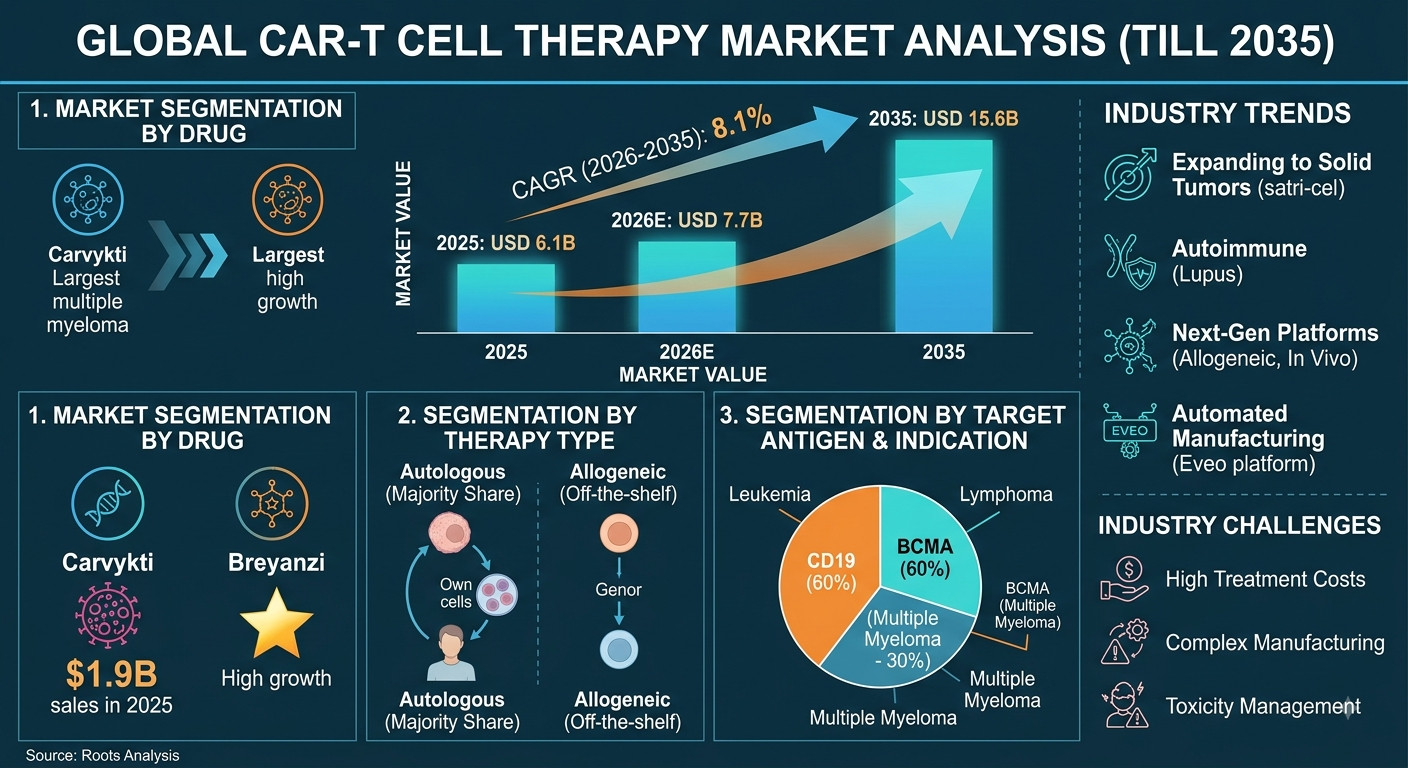
1. Market Size & Growth Forecast
2025 Market Value: USD 6.1 billion
2026 Estimated Value: USD 7.7 billion
2035 Projected Value: USD 15.6 billion
CAGR (2026–2035): 8.1%
2. Market Segmentation Highlights
By Leading Drug: Carvykti holds the largest market share, driven by strong clinical performance in multiple myeloma ($1.9B net trade sales in 2025 across 10,000+ patients). Breyanzi is projected to experience rapid growth.
By Therapy Type: Autologous CAR-T cell therapies dominate due to established commercial presence and FDA approvals.
By Target Antigen: CD19-targeting therapies capture over 60% of total market revenue across B-cell malignancies.
By Target Indication: Multiple myeloma represents over 30% of the market share, led by BCMA-targeted therapies.
By Region: North America maintains market leadership due to advanced healthcare infrastructure and favorable reimbursement frameworks.
3. Industry Trends & Key Developments
Solid Tumors & Autoimmune Expansion: Breakthroughs include regulatory progress for satri-cel (CT041) in Claudin18.2-positive gastric cancer and early clinical trials applying CAR-T in severe lupus.
Next-Generation Platforms: Industry shifts toward allogeneic ("off-the-shelf" candidates like Cellectis' lasme-cel and in vivo approaches like Legend Biotech's LB2501.
Automated Manufacturing: Platforms like Sartorius' Eveo Cell Therapy Platform aim to lower production costs and reduce turn-around times.
Key Commercial Approvals: Regulatory updates include expanded approvals, such as Kite Pharma's Tecartus for mantle cell lymphoma.
4. Primary Industry Challenges
High treatment costs and complex ex vivo production logistics.
Vein-to-vein turnaround times for autologous cell expansion.
Management of severe toxicities like Cytokine Release Syndrome.
https://www.rootsanalysis.com/....reports/car-t-cell-t